
Building for Now and for the Future
26th March 2026
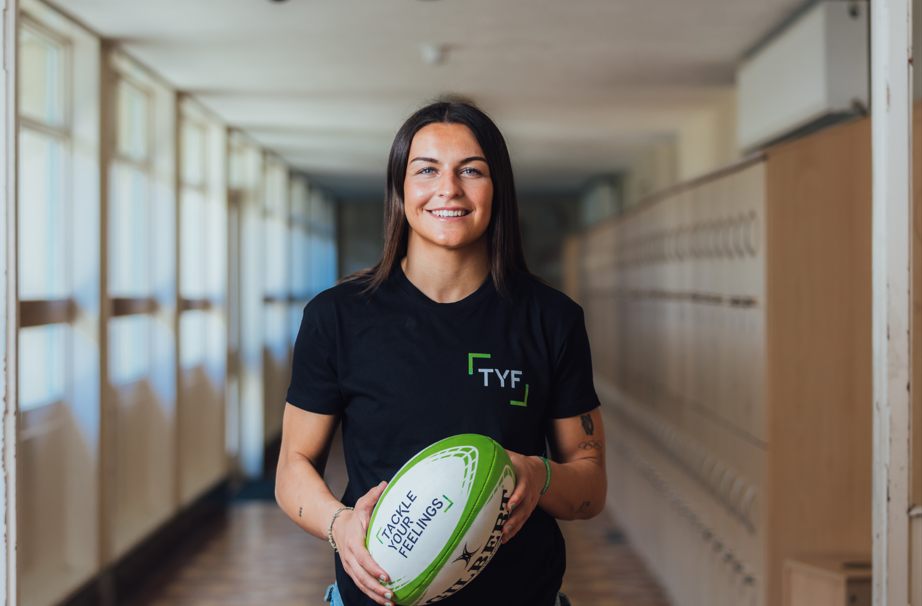
Erin King is impossible to miss on a rugby field. She plays as though she is plugged into a socket, humming with energy, bouncing from play to play, making an impact with her every involvement.
She is the kind of player whose presence alone can often tilt a contest. Her abrasive demeanour raises the temperature of any game she plays, injecting urgency to a point where stillness feels impossible.
So when injury took her away from the action last year, it didn’t just remove her from the team sheet. The pitch had always been where her personality found its fullest expression and without it she was suddenly left with a void she had never really known.
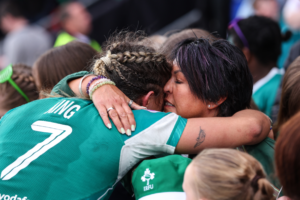
Forced to slow for the first time in her burgeoning career, King discovered how quickly the rugby world can move on from a player used to sprinting through it.
Her rapid rise through the game had been enough to suggest the momentum was permanent. A contract at 17. The World Series. A gold medal in Perth. Paris 2024. A seamless switch to the 15s game and a World Rugby Breakthrough Player of the Year award before she even time to consider what any of it meant.
Success seemed to flow so easily that reflection never really felt necessary.
“I never really had the time to stop and think back on it all,” she says. “There was always the next thing. Like, there was just a few weeks between playing at the Olympics and then the Black Ferns game in WXV.
“I was very young coming into the system and you tend to just go along with things. I’m still only 22, and would like to think I have it all ahead of me but in some ways it has been nice to take stock of how far I have come.”
Pausing may have felt indulgent but sport has a way of enforcing reflection when it chooses. When King injured her knee against England in the Six Nations last April, the pace finally broke. The damage was such that her dream of playing at the Rugby World Cup later in the year was immediately put to bed.
What followed surprised many. Known to be one of the toughest operators in the game, King opted against retreating behind that persona. Instead she chose to openly confront the fears and uncertainty that surrounded her future.
“It’s going to be tough,” she posted online at the time, “and I’m scared.”
In a dressing room culture that tends towards resilience over vulnerability, her honesty was pronounced. Campaigns like Tackle Your Feelings have worked to create space for this kind of chatter, but it still demanded courage. King did not dress it up.
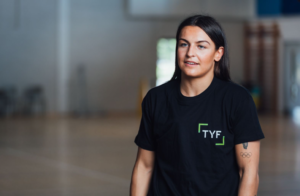
“I didn’t over think it,” King says. “Through initiatives like TYF, mental wellbeing has become part of our everyday language, and I just said what I was feeling in that moment.
“The mental side of rugby is massive now,” she adds. “I was always fairly happy-go-lucky and I think that fed into my rugby. When you’re playing well and enjoying it, you don’t really stop to think about why.
“All of a sudden I was in a different space and the balance shifted. I didn’t have that outlet I’d always leaned into. I tried to keep smiling, but there were some dark moments in there.
“When you think about it, most young players will have only ever known success. So when they hit their first real roadblock it can come as a bit of a shock to the system. Injuries, non-selection and the pressure of playing at the highest level catch up with all of us somewhere along the line.”
In King’s case, serious injury brought about that reckoning. In those first few weeks, long and quiet days appeared where busy ones once lived. Rehab became her new order, and with it came with its own frustrations, not least being locked into a straight-leg brace for 12 weeks.
“I found it really tough at times,” she concedes, “but just because I was going through a bit of a sad time didn’t mean I had to become a sad person.
“I was getting through the work with Ed Mias and with every passing day I had to convince myself that I was getting better, even if it didn’t feel like it. Every morning had to be seen as a new step in the right direction.
“I was recommended a load of coping strategies but it’s a very personal experience. You have to find what works for you, and I found mine almost accidentally.”
Very quickly, King realised that above all else she needed to protect her peace. This meant doing things for herself and without apologising for them. It meant saying ‘no’ when others least expected it and she became adept at recognising environments that cost her more than they gave.
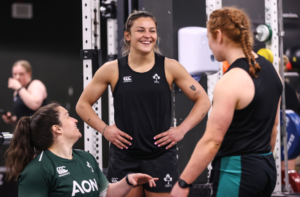
“Throughout my rehab I have to say that never felt excluded,” she points out. “The door was always open to me and there was no pressure to walk through it or not.
“On good days, I loved being around the group and feeding off their company but it wasn’t always like that.
“In the lead up to the World Cup in particular, there were days when just I didn’t want to go to a team meeting. So I didn’t. It was a small, practical strategy but I had to put myself first in those situations, and thankfully it was respected.”
That kind of self-awareness doesn’t always come naturally to elite athletes, particularly young ones. High-performance environments are built on an expectation of sacrifice and availability. King learned, perhaps for the first time, that boundaries are not a betrayal.
Training, too, became a sanctuary. She has always loved the honest of hard, physical effort and so she came to embrace the early mornings and the early flow of endorphins before the rest of the squad landed out to training at the the IRFU’s High Performance Centre. Long and punishing hours though they may have been, she found that her idle thoughts disappeared into beads of sweat.
“I think the girls probably saw my good side more often than they’d have anticipated because most days I was already up and at it. Having my work done as they were coming in also meant I could tap into the things I missed most. You don’t know how good the craic is until it’s gone!”
As an energy giver, King’s presence was always appreciated by the wider squad. She thrives on noise, on camaraderie, on the easy chaos of teammates together. Match days, captain’s runs, the back of the bus are her natural habitats.
The thought of being left on the outside therefore brought a quieter fear: that without rugby, she might lose something of herself. It crossed her mind that the version of Erin who lifts others would fade when she was no longer in the middle of it all.
She needn’t have worried because when her own energy reserves ran dry, her teammates were always able to step in and ensure she remained connected.
They cooked for her. They baked. They drove. When she couldn’t manage the stairs, they moved her bedroom downstairs without telling her. Barbecues filled her garden and laughter filled her house. Hear teammates and friends showed up again, and again.
Loyalty, she says, is one of her core values and during her toughest months, it came back to her tenfold.
There was also space to live outside of rugby’s rigid calendar. Without any sense of guilt, she was able to attend festivals, spend valuable time with friends, and she even went backpacking solo in Vietnam. These were moments of joy that would never fit into a training schedule.
“It was great fun but I’d be lying if I said it was all sunshine and rainbows,” she notes. “If given a choice I know where I’d rather have been, to be honest.
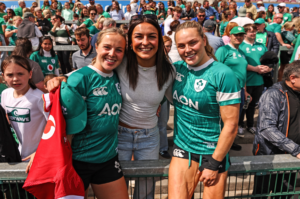
“I went to most of the games during my injury and it was harder than I expected,” she concedes. “I remember closing my eyes at the anthems and I couldn’t help but feel this pang of jealousy. For those few seconds you think ‘this was supposed to be my moment.’
“I think any injured player will recognise that feeling. It was uncomfortable at first because you want to be there to support your teammates, but I think it’s only human for those emotions to surface. You’d be worried if they didn’t!
“You can’t dwell there though. You have to feel it, sit with it and let it go. In the end I’d like to think I supported the girls as I know they would have supported me if the shoe was on the other foot.”
While she made the most of her time away, it hasn’t changed how much rugby matters to Erin King. However, it has clarified why it matters. She speaks with a deeper appreciation now for the people around her and the privilege of being part of an environment that asks so much because it offers so much in return.
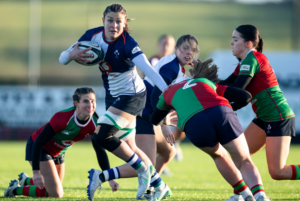
“It’s a bit mad but in five years’ time, I’ll probably look back and be thankful for this whole experience,” she says. “As difficult as it was, it has given me a completely new perspective.”
While she has a multitude of ambitions she has yet to fulfil in the game, she will not let them consume her. Rugby no longer carries the entire weight of her identity. There is now room alongside it for the things that exist beyond the whitewash.
However, that understanding does not dilute her hunger. If anything, it sharpens it.
King knows now that nothing in rugby is guaranteed. Not selection. Not the next game. The certainty she once played with has been replaced by gratitude, and an awareness of just how quickly things can be taken away.
The goals remain, but they are grounded rather than frantic. A return. Another chance. Another jersey. No doubt her Wolfhounds jersey worn on her return occupies a special place in her mind.
And when Erin King she does pull on green again, as she surely will, it will carry a deeper meaning. Because sometimes the longest road back is not to the pitch, but to yourself.
Back to News