
Building for Now and for the Future
26th March 2026
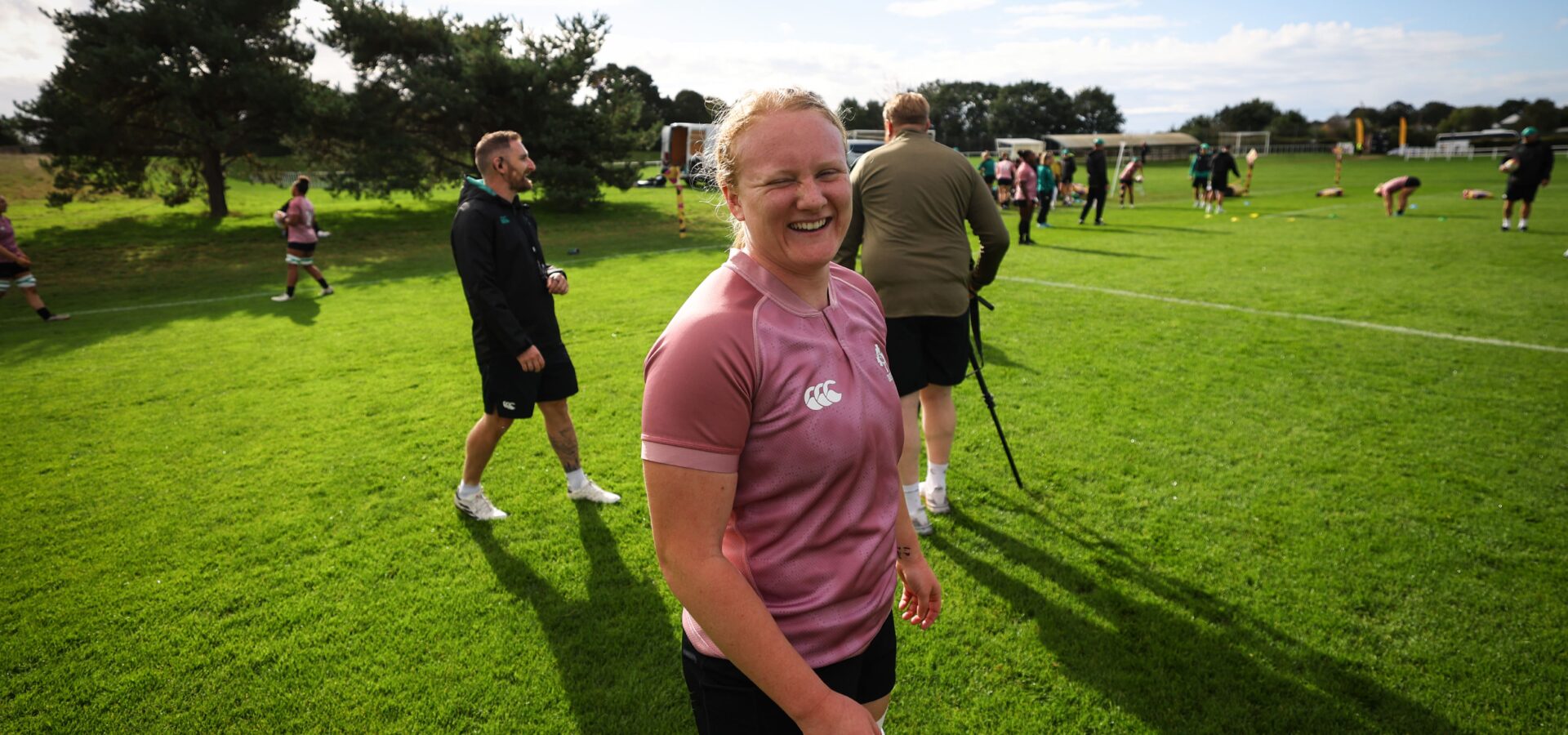
It seems strange to think that Aoife Wafer was little known on the international rugby stage not long ago. Having made her Irish debut in 2022, the Wexford woman navigated a succession of significant injuries before she was truly able to announce herself almost two years later.
The dynamic Irish back row has since established herself as one of the most exciting forwards in the game, earning plaudits across the sport, including being named in World Rugby’s Dream Team of 2024, and claiming Player of the Tournament honours in the Women’s Six Nations Championship last year.
As the next tournament looms large, Wafer’s on-field exploits are likely to continue capturing headlines and accolades. However few will realise the real depth of her commitment.
In recent years, the 24-year-old had grown used to travelling between her home in Gorey, UCD, and the High-Performance Centre in Abbottstown. Now, she is adjusting to a very different commute. Based in Guildford, just outside London, she plays her rugby with Harlequins Women while continuing her physiotherapy studies at St Mary’s University in Twickenham.

It had always been a demanding balancing act but the move to England has thrown up fresh challenges. Thankfully, the change has been made a little easier with the support of the Ireland Sports Fund (ISF), which provides financial assistance to athletes pursuing education alongside their sporting careers.
Having been pointed in the direction of the ISF by Rugby Players Ireland, Wafer submitted an application along with 60 other players. It was a decision that came from a very clear and practical place.
“University fees are very expensive in England,” she says, simply. “I had lost a contract with the IRFU and the cost of moving to England put an additional strain on things. To be honest, it’s the kind of stress you don’t really want to think about as a player.
“So applying for the ISF was just a case of, ‘you know what, I’ve got as good a chance as any at this,’ and so I gave it a shot. It was a timely boost when it came through.”
While the bursary has been a significant help in overcoming the burden of fees at St. Mary’s University in Twickenham, Wafer has also come to appreciate the wider value of being part of the ISF programme.
“What I like about the Fund is that it has connected me to a lot of other players who are in a similar situation to me,” she notes. “As a female athlete there’s probably still a need to balance a career alongside rugby because at the moment we don’t earn enough in sport to be able to retire and live comfortably.
“But I’ve enjoyed learning about some of the lads who are also taking a dual career approach. Some are only starting out in their rugby careers, and there are others who have other things going on because it helps them switch their focus and improve general performance.
“As a player, there’s something reassuring about seeing other athletes in the same boat as you.”

Education has always been an essential pillar in Wafer’s career, yet the combination of high-performing sport with university life is far from straightforward. A demanding schedule awaits every day.
She therefore believes there should be greater infrastructural support to make the process easier for elite athletes trying to build dual careers.
“I think there’s a few sides to it,” she begins. “I think the education system could do more to help elite athletes. They want us in the university ecosystem but I think they struggle to appreciate how tough the balance can actually be to manage.
“I appreciate there’s only so much the university or players’ association can do, and so the player should have a better understanding of their responsibilities. I think every student elite athlete should be educated on how to prioritise different things or how to organise their time better. Managing time is a bigger issue than people think.
“There has to be a bit of a mindset shift too. I realised pretty quickly that if I was stuck on a bus for a few hours somewhere, it wasn’t the time for Netflix. I needed to see it as an opportunity to get some study done.”
Interestingly, Wafer has found that her experience studying in St. Mary’s has offered some practical solutions to the challenge of balancing sport and education. As an institution with a strong sporting focus, Wednesdays are free of lectures which enables Wafer to dedicate a full day to study and recover.
Away from the lecture halls and rugby pitches, Wafer is enjoying her new life in England. Living with teammates Laura ‘Bimba’ Delgado and Alex Callender, she has settled well into the green, open surroundings of Guildford which feel reassuringly close to home.
This familiarity proved helpful in the early days of her move. A broken collarbone and a re-rupture of her medial collateral ligament in Ireland’s World Cup quarter-final defeat by France, meant she was forced to spend much of that time on her own in rehab mode.

While frustrated not to have been able to hit the ground running with Harlequins from day one, the experience has helped further shape her perspective on the profession she hopes to enter one day.
“I’m a bit of a nerd,” she reveals. “When I pick up any injury, I always look up any research papers that I can get my hands on. On top of that, during the World Cup I was able to work with people like Ed Mias and Emma Galvin who are physios at the top of their game.
“It was a bit like work experience!” she adds. “I was learning and developing my own unique point of view as I went through my rehab. Having experienced a few injuries in my career, I feel that when I go out on placement now I can really connect with patients because, ‘I know how it feels.’”
Given her abrasive playing style, the knocks have always been part of Wafer’s journey. However, she feels as strong as she has been for some time. Having been well looked after on both sides of the Irish Sea, she is now reaping the rewards of that work.
That sense of building momentum could not come at a better time. With another edition of the Women’s Six Nations approaching, Ireland will be hoping Wafer can once again replicate the form that saw her become one of the tournament’s standout performers, and consistently set the highest of standards.
“I’m buzzing to be honest,” she says. “I feel strong, I feel fast and I feel fresh. It’s also the first time I’ll be going into a block or a camp as a PWR (Premiership Women’s Rugby) player as well. So having been away I’m really looking forward to spending some proper time with the girls who are based at home. There’s a fresh energy to that.
“The aim is to build on last year’s Six Nations,” she adds. “It’s an incredibly exciting time for this team. Every year we seem to be breaking new ground and I hope that trend continues.
“On a personal level, I’m also keen to kick on. Last year I had the honour of being named Player of the Tournament, the first Irish woman and the youngest woman to do it. So I’ve set a very high standard there, and it’s one I intend to back up.”

It seems a safe bet that Wafer’s performances will be in the headlines again over the coming weeks. The real story, though, will continue to lie in the quieter, unseen work that takes place in the background. It’s the kind that rarely makes a highlight reel, yet shapes everything that follows.
Support systems like the Ireland Sports Fund are part of that unseen work. They may not shout the loudest, but they matter because they empower players like Wafer to keep training, studying and building something beyond the game.
And perhaps that is the measure of it all. Not just the awards or the rising reputation, but the sense that there is more still to come.
Between Guildford and Gorey, the lectures and training sessions, Wafer is determined to keep developing. And that is a frightening prospect.
Back to News