
Highlights: March 2026
31st March 2026
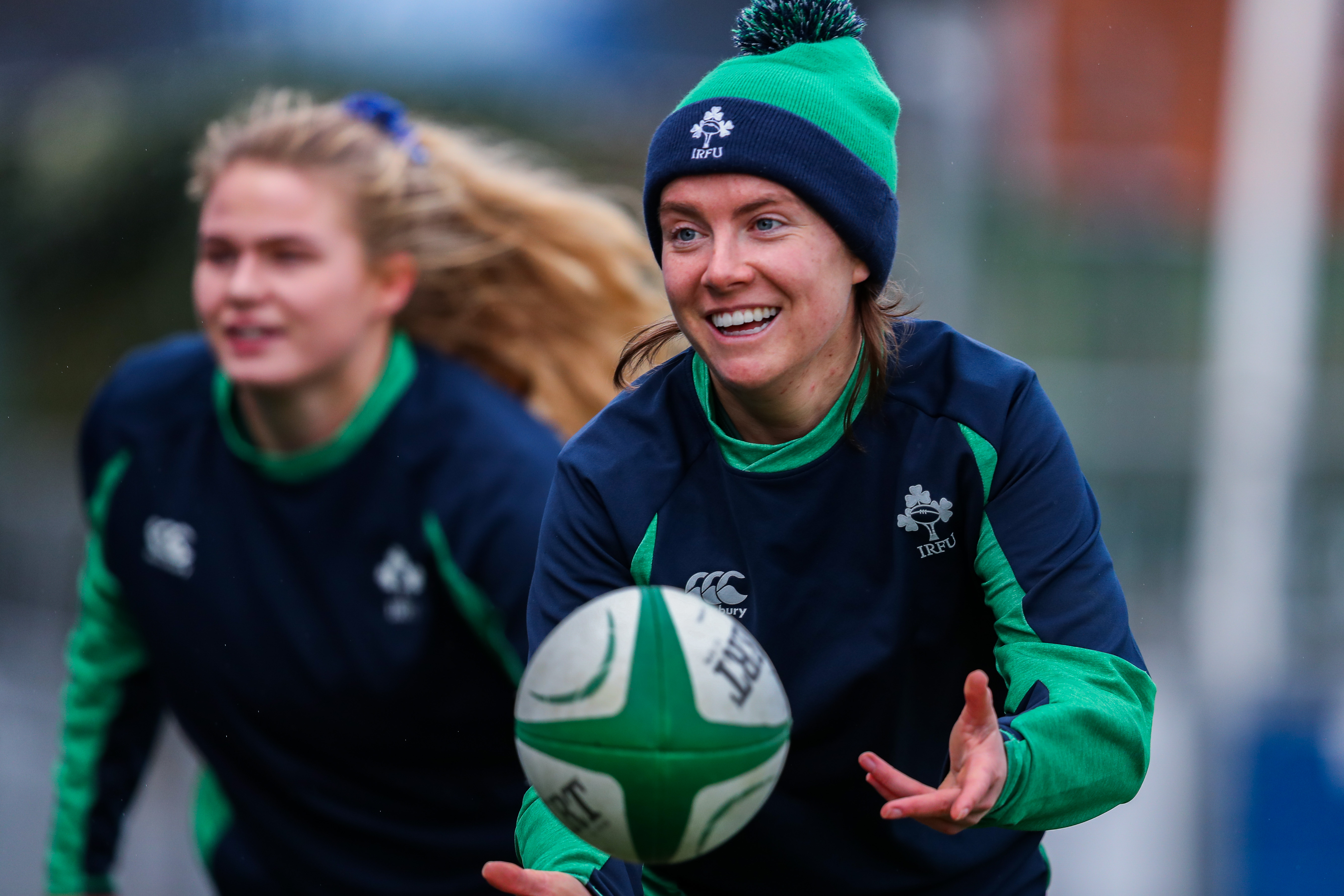
As part of our Affinity Scheme relaunch, we spoke with former Irish international Ellen Murphy about her new business Abhainn Sauna.
Ellen Murphy was 26, scaling the heights of her sport and settling into a medical science career she had been carefully building in the UK. Life felt settled, the pieces falling into place, until a routine tackle that meant little to anyone else came to mean everything to her.
For some athletes, that moment can arrive as something of a full stop. For Murphy, it was a comma for what followed was not retreat, nostalgia or bitterness, but an opportunity to set a new course without losing the rhythm of the old.
Today, the former Irish international is a specialist medical scientist with the Health Service Executive (HSE), nearing completion of an executive MBA, and co-founder of a riverside sauna business just outside Killarney. It is a full, varied life, and one that still carries echoes of the game she once chased so relentlessly.
Her latest venture reflects both her drive and a growing appreciation for moving at a different pace. Nestled beside a river in the Kerry countryside, Abhainn Sauna feels a long way from where her rugby story began.
By most standards, Murphy’s introduction to the sport was a late one. She grew up in Longford with a football in her hands and the promise of an inter-county career stretched out before her. Rugby arrived almost by accident, initially little more than a way to keep fit.
She first picked up a rugby ball in her second year of biomedical science at UCC. Before long, it had slipped into a life already crowded with ambition. Over the next eight years, that whim would take her further than she ever imagined.
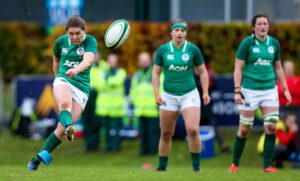
It was an era when Irish women’s rugby was still straddling amateur and semi-professional realities. Determined not to stall her off-field ambitions, Murphy balanced lectures, lab work and international training camps in a schedule that left little room for pause. It was relentless.
“There’s a quote that has always stuck with me,” she says, thinking back to those hectic days. “‘Drive is the thing that pushes ordinary people into doing extraordinary things.’ Now, I’d consider myself pretty ordinary, but I like to think I’ve plenty of drive.”
Indeed her energy and focus had to be constant, because over time her commitments began to shape her choices. The demands on her schedule were no longer incidental; they dictated how she trained, worked and planned her days.
“There were plenty of times when I definitely questioned it all,” she concedes. “Now when I look back I think about the fact that I got to play in front of 82,000 people at Twickenham on my international debut. That was one of the proudest moments of my life, and it can never be taken from me.”
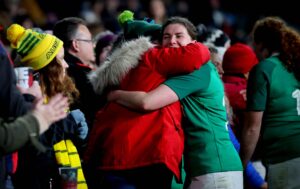
Murphy’s introduction to Test rugby was certainly a baptism of fire. Originally named on the bench, she was thrust into the starting XV moments before kick-off following an injury to out-half Nikki Caughey.
“That game confirmed to me that I needed to get to the UK to further my rugby career at that time,” she says. “To make my debut was a huge milestone but once I’d hit that goal I began chasing the next. That’s how my competitive mindset has always worked across all areas of my life.”
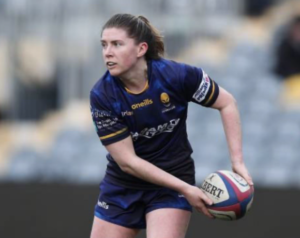
All the while, Murphy remained conscious of the sport’s fragility, and of the importance of life beyond it. When she signed with Worcester Warriors, she also secured employment with the NHS, working out of Wye Valley Hospital in Herefordshire. Her maintenance of a dual identity would prove crucial.
At Worcester, Murphy shared a dressing room with World Cup winners and international captains. The standard was high, the environment intense, and she was only beginning to find her feet.
Then came the concussion.
There was no dramatic collision or obvious warning sign. By her own admission, it was a run-of-the-mill tackle and though she initially felt a little off, she quickly brushed it aside.
“I remember getting up after the hit and feeling a bit strange alright,” she recalls. “I began to wonder if I was just overstimulated from the caffeine gum or something. It wasn’t until two or three days later that things really surfaced.”
When they arrived, the symptoms were persistent and disorienting: facial pressure, vestibular issues, and a constant sensation of movement. Murphy was to find that post-concussion syndrome has a cruel subtlety: it can be deeply disruptive to the person experiencing it, yet largely invisible to others.
“It’s a very individual thing,” she adds. “After I while I could manage the physical symptoms, but what worried me more was the wider impact it was having. I noticed that my tolerance for stress dropped, and even though I’m shy by nature anyway, it seemed to amplify social anxiety.
“Thankfully, I recognised that something wasn’t right quite early. I reported everything and engaged fully with medical teams who referred me to a specialist in Birmingham.”
With her medical science background, Murphy also conducted her own research through which it soon became clear that there would be no quick fix. Her rugby days were numbered, and there was little value in resisting that reality.
“Once you understand it and have the right tools in place, it’s manageable,” she says. “But I wasn’t able to return to team sports or anything. Even minor knocks were an issue.
“For someone in their mid-twenties, at peak fitness and involved with teams all their life, that was pretty gutting. And it still is. But that’s sport and that’s life, isn’t it? You play the hand you’re dealt.”
Crucially, when rugby fell away, everything else did not.
Returning to Ireland, Murphy found work with the HSE based out of Limerick, and is now a specialist medical scientist in histology – the study of the microscopic structure of cells and tissues.
Her work involves complex cancer specimens, helping to ensure surgeons have removed all traces of disease and assisting in determining the most appropriate treatment pathways. It is meticulous, high-pressure work.
“There’s a lot at stake,” she says. “You don’t get a second chance at these samples. And you’re always aware that behind every slide is a patient and a family at one of the worst moments of their lives. That gives the job a real sense of purpose.”
That sense of responsibility has prompted Murphy to think more broadly about leadership, decision-making, and how people and teams perform under pressure. Her curiosity has led her to an executive MBA at DCU, a step she sees not as a departure from her work, but as an extension of it.
Her openness to evolution and reinvention is a recurring theme. More recently, it has taken her to a particularly scenic riverside location, where she and her partner have begun putting her MBA learnings into practice.
“We’d often talked about a sauna business,” she explains, “so when my partner left his job in finance, we decided to explore it properly. We had access to land outside Killarney and felt we had a solid model.
“Those who know me would consider me very measured, but this time we just said: ‘will we give it a crack and see how it goes?’”
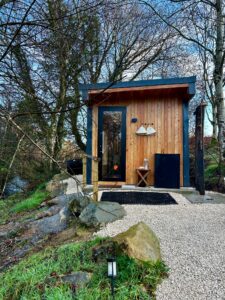
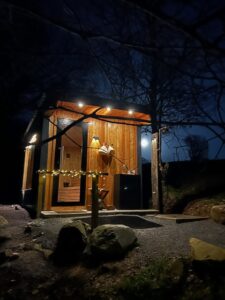
Just months after opening, the answer is already clear. Set beside a river with mountains rising quietly in the background, Abhainn Sauna sits a short drive from town. It’s close enough for locals, while the natural setting draws in Killarney’s bustling tourist trade.
It has quickly found its flow. Plans are already in motion for expansion, including corporate offerings, a coffee dock, and integration with nearby walking routes.
“Health and wellness was always something I genuinely cared about as a player,” Murphy notes. “Some people tried to cut corners, but the benefits of sauna was one aspect I really believed in. It became an important part of my recovery, and it’s a habit I’ve kept since retiring.
“This isn’t a hobby or something to replace rugby,” she hastens to add. “It’s built on values I care deeply about, and it’s grown into a proper long-term plan.”
Thinking ahead is a luxury she sees as one of the great perks of life after sport and its uncertainties. Her MBA is nearing completion, and she’s preparing to run a half-marathon in Mullingar next month. The competitive edge hasn’t gone anywhere… it has simply been redirected.
The shift in focus has meant that Murphy doesn’t often dwell on what she achieved in rugby; there’s too much to busy herself with. But when she does, she frames it without regret.
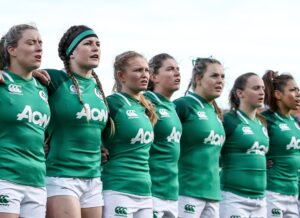
“If I’m honest, I’d call myself a six-out-of-ten player,” she says candidly. “I had to work incredibly hard to reach the level of international rugby, and I came away with seven caps in the end.
“For what I might have lacked in talent, I made up for in determination and I’d like to think I got as much out of it as I possibly could. My only regret is not enjoying it a bit more.”
She pauses.
“It was always about the next thing. You don’t always stop to cherish what you have, and just like that…” she says, clicking her fingers, “it can all be taken away.”
Life, though, doesn’t stop. It simply asks a different question.
“For most players, you never know when the last time you’ll tog out will be,” Murphy reflects. “ So I’m grateful that I’d built something beyond rugby. It meant there was still somewhere to go.”
Now, a new life is taking shape beside a river in Killarney.
Back to News